
Frequently Asked Questions
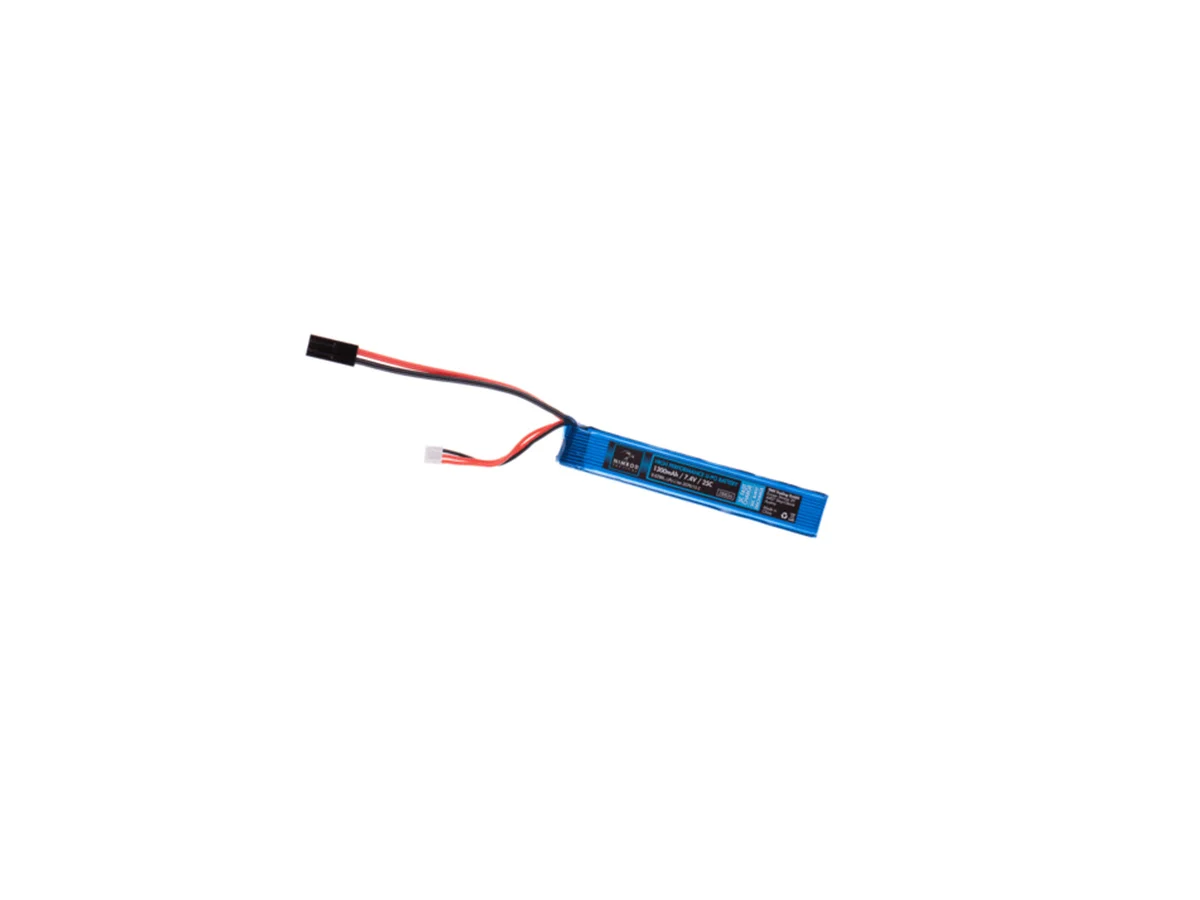
Nimrod LiPo Battery 7.4V 1300mAh Stick Deans
Product code: A1489

Nimrod LiPo battery in a compact stick shape composed of 2 cells resulting in 7.4V with a capacity of 1300 mAh. The battery discharge rate is approximately 25C, providing the necessary current for the replica in most cases.
Equipment Specifications
| Height | 12.5 mm |
| Width | 21 mm |
| Battery Type | Li-Po |
| Discharge | 25 C |
| Battery Shape | Stick |
| Voltage | 7.4 V |
| Magazine Capacity | 1300 mAh |
| Battery Connector | Large Deans |
| Length | 130 mm |
Product Description
Overview
This Nimrod battery is a LiPo type and is made up of 2 cells forming a compact assembly. It has a voltage of 7.4V and a capacity of 1300mAh. The battery technology allows for very small dimensions of the entire assembly, thus enabling installation in very tight battery compartments. The 25C discharge rate allows for optimal current supply for the replica's power needs.
The battery's insulation is well-made, and the wires and connectors are of high quality. This battery is equipped with a large Deans connector.
WARNING:
- Lithium Polymer (LiPo) batteries can be extremely dangerous.
- The user must ensure all safety measures for: potential fire, bodily harm, and property damage.
- In case of improper use, damage, or manufacturing defects, LiPo batteries can cause explosions, fire, smoke, and poisoning risks.
- By purchasing this type of battery, the user assumes responsibility for any risks associated with LiPo batteries.
- LiPo batteries are not toys and should not be left within reach of children as they can pose a real health hazard.
- LiPo batteries should not be thrown into fire, placed in an oven, or microwave as they can explode.
- LiPo batteries contain/may emit electrolytes, toxic vapors, and other harmful chemicals. Handle these batteries with care and avoid any contact with skin, eyes, or other body parts. In case of contact, rinse thoroughly with water and seek medical attention immediately.
- Do not attempt to charge mechanically or chemically damaged batteries.
Actions that lead to battery damage
- Charging LiPo batteries with a charger that does not have balancing and automatic shut-off features.
- Connecting in series or parallel with another cell or battery even if they appear similar.
- Exceeding the maximum and minimum operating voltages.
- A temperature drop or rise outside the permissible limits.
- Excessive charging current.
- Short-circuiting the battery terminals.
- Subjecting the battery to mechanical shocks such as dropping, hitting, bending, cutting, twisting, deforming, or puncturing.
- Contact with liquids.
- Improvising an improper charging setup.
- Using inappropriate, improvised charging cables.
General information
- LiPo batteries are composed of cells.
- The parameters of this type of battery are: Voltage measured in Volts (V), Capacity measured in milliamp hours (mAh), and instantaneous discharge (C)
- Each LiPo battery has a power connector and a charging connector.
- The power connector is used to power the device intended for powering.
- The charging connector is exclusively used for charging the battery. (in some cases, charging is done through both the power and charging connectors)
- The battery is charged using the charging connector, and for some advanced chargers, connecting the power connector is also necessary.
- LiPo batteries are charged with special LiPo battery chargers that have the function of balancing the voltage of each cell and automatic shut-off of the charging.
- Each LiPo battery has a maximum charging rate of 1.05X of the battery's capacity, which must not be exceeded during charging.
- Each cell has a maximum voltage of 4.2V and a minimum voltage of 2.7V.
- During operation or charging, the battery temperature must not drop below 0°C or rise above 50°C.
- For long-term storage of the battery, the battery capacity should be between 15 and 25% of the maximum value.
NRG cannot guarantee that you have used correct operating methods and have adhered to the conditions for charging, discharging, or storing LiPo batteries. For this reason, we reserve the right to refuse replacement, as a warranty, for improperly used batteries (which violate the instructions and warnings above) and are not responsible for material, moral damages, or loss of human life.
Reviews (0)
There are no reviews for this product yet.


 Continuă cu Google